Passan Metal
Stainless Steel Bucket-to-Bucket Milk Transfer Lid 40mm Ports
Stainless Steel Bucket-to-Bucket Milk Transfer Lid 40mm Ports
The milk transfer lid is designed to solve one of the most common limitations in bucket milking systems: restricted bucket capacity. In standard setups, a bucket has a fixed volume (e.g., 30 liters). When milking multiple animals or dealing with high-yield cows, the bucket fills quickly—forcing the operator to stop milking and empty it. This interrupts workflow and reduces efficiency.
The transfer lid eliminates this issue by enabling continuous milk flow from one bucket to another.
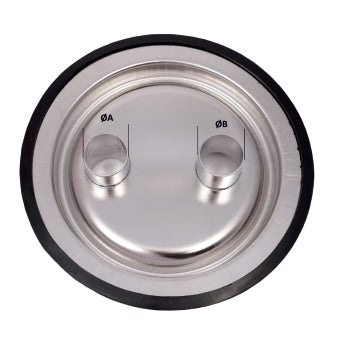
Mounted securely on top of the bucket, the lid features two large-diameter ports that allow milk to move seamlessly between connected buckets. During milking, milk enters the first port and fills the primary bucket. Once capacity is reached, milk automatically exits through the second port and flows via a hose into the next bucket. This process can continue across multiple buckets without interrupting milking.
Difference Between Transfer Lid and Milking Lid
Although both lids fit onto the same bucket, they serve entirely different milking configurations.
A standard milking lid is used in single-bucket systems. It includes multiple small ports for milk inlet, vacuum line, and pulsator connection. Its primary function is to create an airtight vacuum environment and connect all milking lines directly to one bucket. In this setup, milk collects in a single container, and milking must stop once it is full.
A transfer lid, on the other hand, is used in multi-bucket systems. It typically has two large ports—one for milk inlet and one for outlet. While it also seals the bucket and protects milk from external contamination, its key function is to transfer milk between buckets rather than storing it in just one.
In short, a milking lid is for single-bucket operation, while a transfer lid is designed for continuous, multi-bucket milking setups.
How Bucket-to-Bucket Milking Works
In this system, multiple buckets are connected either in series or side by side. The transfer lid is installed on the first bucket.
Milk from the milking machine flows into the first bucket through the inlet port. As the bucket fills, milk level rises and begins to exit through the outlet port, which is connected via a hose to the next bucket. The same process repeats as each bucket reaches capacity.
This setup allows uninterrupted milking, as milk naturally flows from one bucket to the next without requiring manual intervention. It is especially beneficial in operations with multiple animals or high milk yield.
Function of the Ports
A typical transfer lid includes two main ports that work together:
- Inlet Port: Allows milk from the milking machine or previous bucket to enter the current bucket.
- Outlet Port: Activates once the bucket is full, transferring milk to the next bucket via a hose connection.
The diameter of these ports is critical for performance. If the flow rate is high and the ports are too narrow, milk transfer slows down, increasing the risk of overflow. For this reason, 40 mm diameter ports are commonly preferred, as they allow smooth and unrestricted milk flow even during high-volume milking.
Importance of Sealing (Gasket Performance)
The transfer lid seals onto the bucket using a gasket positioned underneath. Proper sealing is essential for two reasons:
First, it protects the milk from external contamination by preventing air and foreign particles from entering the bucket.
Second, it ensures controlled milk transfer between buckets. If there is leakage between the lid and bucket, milk may escape from unintended points instead of flowing through the designated outlet, causing product loss and operational mess.
Since gaskets are subject to wear over time, they should be regularly inspected and replaced when necessary. Even the highest-quality lid cannot perform properly without an effective seal.
Key Selection Criteria
When choosing a milk transfer lid, consider the following:
- Bucket Mouth Compatibility: The lid must match the diameter of your bucket opening.
- Port Diameter: Ensure compatibility with hoses and sufficient flow capacity (40 mm is standard in Türkiye).
- Gasket Quality: Check material, flexibility, fit, and availability of replacements.
- Ease of Cleaning: Smooth internal surfaces reduce milk residue buildup and simplify cleaning after each milking session.
Specifications
CODE - PS41
ØA - 38 MM
ØB - 38 MM
ØC - 245 MM
TUBE TICKNESS - 1 MM
WEIGHT - 0,85 KG
Shipping
We offer global shipping for our entire product range. To receive a formal pricing proposal and shipping details, please use the Get a Quote button
Share